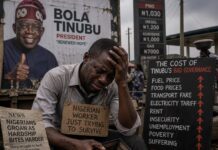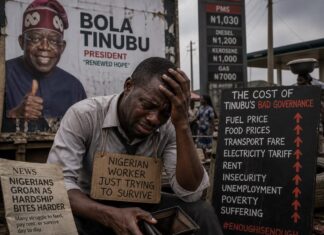


The perspective of Remi Tinubu, the First Lady of Nigeria, that women should consider starting small businesses such as selling akara, roasted corn, kuli kuli, groundnuts, and similar items to earn a living, recently elicited a wide-ranging debate in Nigeria. Many people pointed out that this is not the most appropriate way to address poverty and the high incidence of unemployment. However, some have argued that people should not trivialize humble beginnings. The vast number of people employed in the informal economy highlights that this sector is the mainstay of income generation for many.
This reference to survivalism through akara is not new. Even before Nigeria reached its current dire straits under the APC regime, such discussions existed. When the debate started, I recalled a discussion on the inaugural television show “Politricks” on Ben TV in the UK, anchored by Kayode Ogundamisi. I was part of that show, and I remember that years before 2012, there was a story in one of the major daily newspapers about an engineering graduate who, unable to find a job, began preparing and selling akara and was making a living from it.
My argument at the time was that we need to go beyond focusing on individual income and survivalism, and instead address the broader question of socioeconomic development. I pointed out that while newly industrialized countries like South Korea were utilizing the knowledge and skills of their engineers in fields such as electronics, robotics, and car manufacturing, we were commending an engineering graduate’s supposed ingenuity in surviving by selling akara. That story was from the early 2000s. Two decades later, Nigeria still relies on such means for poor working-class people to survive.
Within this context, some believe that selling akara is better than starvation. However, there is something missing in the argument, even among those who insist that Nigeria needs more than akara selling and the informal economy to leapfrog in its development. What is missing is an understanding of the systemic nature of why we are having this discussion in the first place.
At the heart of this issue is the evolution of global capitalism and the position of an economically backward yet resource-rich country like Nigeria. Capitalism is a system that thrives on accumulation and has passed through several phases. Its default mode is liberalization, or the free market. Within this, production is central—production and reproduction of life and the means for life, including food, consumer goods, and machinery.
After the Great Depression of 1929 and World War II, capitalism experienced what has often been described as its “thirty glorious years,” from the late 1940s into the early 1970s. During this period, manufacturing and the welfare state were the norms in the Global North, while interventionist and developmental states emerged in the Global South. In Nigeria, this context saw the earliest efforts at establishing agro-industrial complexes and import substitution industrialization, as part of the broader decolonization of Africa. Several countries invested massively in social services, making healthcare and education widely accessible. State-owned enterprises flourished. Corruption existed, but it is not peculiar to Africa or the Global South; capitalism’s logic itself breeds corruption.
It is important to stress that the developmentalism and welfare logic of that period were not simply acts of capitalist benevolence. They were responses and concessions to the fightback by working-class people after the Great Depression, in the wake of mass unemployment, and to the national liberation struggles in Africa and Asia.
By the late 1970s, capitalism reverted to its default position, ushering in what has been described as neoliberalism. In Nigeria and the rest of Africa, the first step in this direction was the structural adjustment programs of the 1980s. National development plans were replaced by market-based rolling plans. Industrial policy, which was inadequate even at its best, disappeared from discourse. Non-development became the order of the day. The informal economy expanded, and even the formal sector experienced significant informalization, with increasing casualization of labor and job insecurity.
This is why it is not only the poor or the uneducated woman, as in Remi Tinubu’s proposition, who is underemployed. It is not just about survival; no society can develop simply through survivalism. Meanwhile, as the situation of working people has become more precarious, the ruling class has become extremely wealthy at the expense of the majority, through the pilfering of national resources. The same people, like Remi Tinubu, who urge the poor to focus on survival, possess more wealth than their generations could ever spend. Yet, due to the logic of the current form of capitalism, they are less inclined to implement measures and policies that could foster industrialization.
Those who believe that modernization or industrialization can come from the goodwill of the ruling class, or can be globalized within capitalism, fail to realize that what is needed is systemic change—a revolutionary challenge to the system. Only the defeat of the ruling class can ensure lasting development, through their expropriation and the redistribution of wealth they have hoarded while the poor become poorer.
If we fight, we may win or lose. If we do not fight, we have already lost without lifting a finger. The ruling class understands this. Arguments urging people to focus on survivalism instead of challenging the system are meant to numb the possibility of resistance and struggle for change.
The period when capitalism allowed for some development was because earlier generations dared to fight for more than what capitalism offered. The balance of power did not result in their complete victory, but it led to what has been described as a social compromise.
We cannot develop by debating over akara selling. It would be foolhardy to think that the alternative will come only through arguments. We need not only to speak truth to power, but also to fight to change the reality that mocks working-class people while enriching others.
By Bàbà AYÉ