
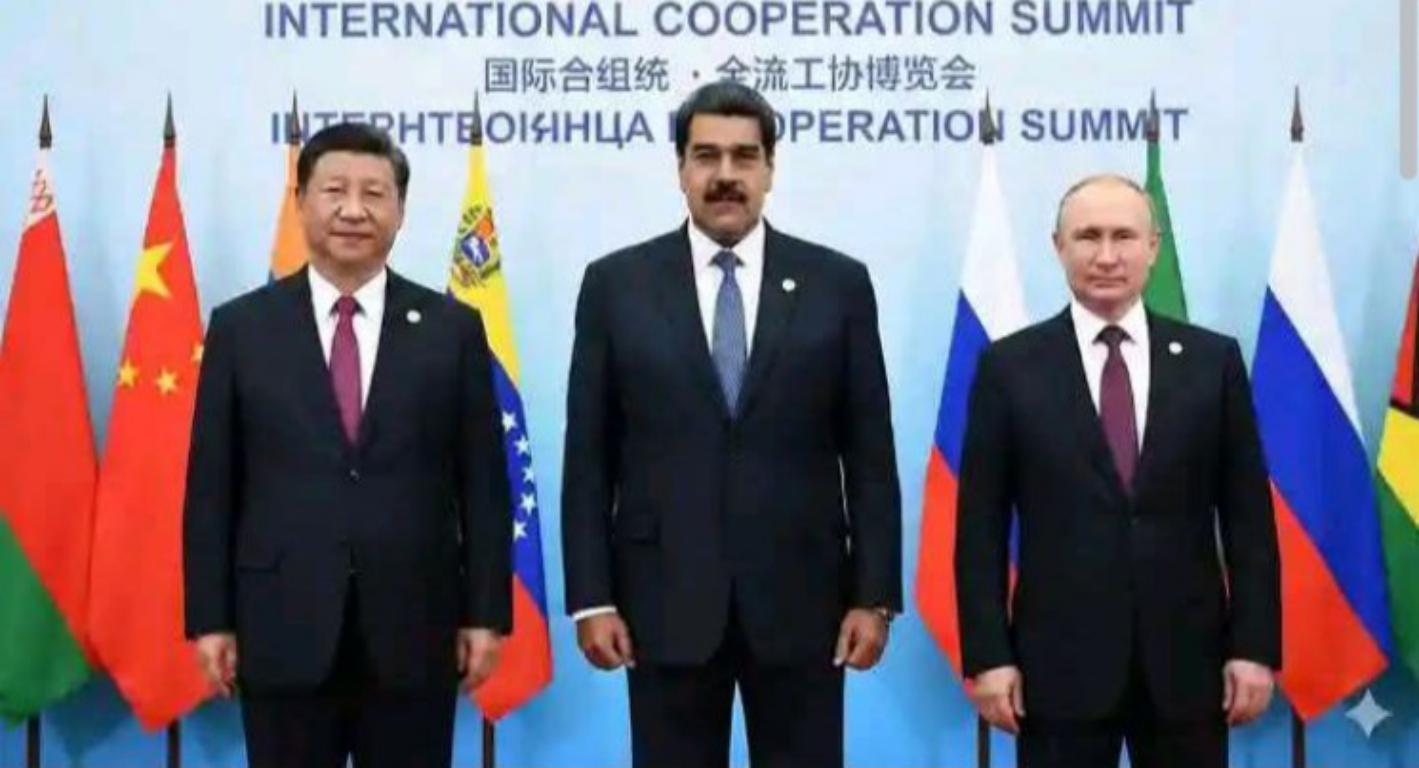
The United States’ airstrikes and military operation on the ground led to the capture of Venezuelan President Nicolas Maduro in Caracas, the Venezuelan capital, on 3 January 2026. He has subsequently been charged with various ridiculous charges in a New York district court. While the invasive military operation led to the abduction of President Maduro and his wife, who is also a member of parliament, it cannot be considered a regime change as Vice President Delcy Rodriguez has stepped into the role of president.
Donald Trump did not carry out a full regime change to install the “opposition” leader Marina Corina Machado, as contrary to Western propaganda, despite Venezuelans frustration with worsening living standards and repression under the Maduro regime, she and the liberal opposition she leads is actually not popular enough. A new regime based on her party and allies would cause further unrest in the country, without being able to resolve the contradictions that had unfurled under Maduro. Trump also claims that the new President, Ms. Rodriguez would do what America says and give them the oil. And there have been reports in the news that, though Ms Rodriguez might not have supported the invasion, she had expressed a readiness to work with the United States to run Venezuela, even before the invasion. However, she still asserts that Maduro remains the president, and has recently said she has had enough of being ordered around by the United States.
Since January 3, people have said a lot about the continued relevance or legitimacy of international law in the mainstream press. Liberal pundits and talking heads are shrieking in fear that Trump has ended the age of the “rules-based order”. The same concern is expressed on the domestic front by liberals in the United States who are more concerned that the country’s president did not seek the approval of the US congress, than with the act itself.
But a closer look at the history of capitalism shows that international law has always been enforced by imperialist countries over colonies and neo-colonies. Imperialist countries have often got away with breaking those same laws. And we must not forget that this is not the first time the United States has gone into a country in Latin America and abducted its leader. It did that to Manuel Noreiga of Panama, who was a former ally of the US on 3 January 1990 and charged him with various counts of drug trafficking in Florida. One could say that liberal reactions on the importance of international law resemble a child realising that Santa Claus is not real.
Conversations in some anti-imperialist media and online spaces are also interesting. These conversations ranged from those disappointed that some states such as China and Russia, which they consider as anti-imperialist opposition to the United States, failed to intervene on the side of Venezuela against this condemnable unilateral action, in the spirit of “multipolarity”.
I will broadly categorise these groups with their lively discussions on social media platforms like X and Instagram into two broad camps. The first comprises anti-imperialists who believe that a multipolar world solves the primary contradiction, which to them is the American or Western imperialist domination and exploitation of poorer countries of the global South. They stand for Pan-Africanism or Pan-Arabism and in some instances reject Marxist analysis which they chalk up to a euro-centrist worldview that is not universally valid.
To them, the primary contradiction is race, nation, or even, sometimes, religion. Their idea that Marxist theory cannot apply to non-White civilisations is ahistorical. It avoids the facts that even within nations in Africa and the Arab world there have always been classes of exploiters and the exploited. And more importantly today with global capitalism, the working class and the capitalists are pitted against each other in all countries of the world and globally.They seem to ignore the fact that we live in an age of global capitalism in which the Marxist method is the most accurate method for understanding not only our history but also the society we live in today’s world.
The second group comprises young people who align with Marxism as ideology, appreciating the primary place of the economic system. But while they generally understand that the primary contradiction is capitalism, they overestimate the role multipolarity will play in anti-capitalist liberation, losing sight of the fact that the liberation of the working class must be done by the working class itself and not by some state power or the other claiming to represent workers.
Due to this perspective, they look for Marxism and anti-imperialism in places where such are lacking. There is nothing revolutionary or anti-imperialist about the rise of China or Russia’s stance against the United States, for example. Marxists must not lose sight of the fact that the party in power in Russia is an ultra-nationalist right-wing party whose political philosophy is in part inspired by the anti-Communist philosopher Aleksandr Dugin. Vladimir Putin has also demonstrated that he is a fan of Tsarism and likened his invasion of Ukraine to Peter the Great’s invasion of Sweden.
China, on its own part, is a place of consolidated monopoly capital which is now looking for new sites of extraction mostly in Africa. We should also not forget that it is the country with the highest number of billionaires after the US. How can any such country be socialist, if that word is to still hold any liberatory, anti-capitalist meaning to us as working-class people? China is one of the most unequal countries in the world with a Gini coefficient of 0.467 according to the Chinese government itself, and 0.5-0.6 according to some other academic sources. A Gini coefficient this high shows massive inequality. In fact, BRICS nations have some of the highest inequality rates in the world, with South Africa experiencing the highest. This shows that the BRICS alliance is nothing more than an alliance of newly industrialised capitalist countries.
Although Gini coefficient is not a perfect metric for measuring inequality, it is a very useful tool. And the problem with considering BRICS countries as being in anyway representative of liberatory politics goes beyond the matter of inequality. Apart from improving trade relations for their states, they have no other serious political agenda apart from anti-United States politics that is rooted in any revolutionary project. Essentially the BRICS can best be considered as a watered down, more exclusive, and strictly economic 21st-century version of what was the Non-Aligned Movement (NAM). During the early 1960s NAM was a movement that many people thought had potential, but it did not last long. One reason obviously was the imperialist aggression of the United States, but another reason is the limitation of what they stood for. They were anti-colonialist without being anti-capitalist, rather seeking accommodation within the global circuit of capital than to overthrow the capitalist system.
by Emmanuel IRO-OKORO