
“There are decades where nothing happens; and there are weeks where decades happen.” This is a quote that is often attributed to the Russian revolutionary Vladimir Lenin. But, what he said in pamphlet titled The Collapse of the Second International was “It is not every day that a revolutionary situation exists; but there are periods when the development of the situation proceeds at a speed ten times as great as in ordinary times.” Both statements capture the spirit of the times we live in today.
Another relevant quote is that by Antonio Gramsci: “The crisis consists precisely in the fact that the old is dying and the new cannot be born; in this interregnum a great variety of morbid symptoms appear.” These quotes certainly encapsulate the present period, more especially since the new Donald Trump government came to power in the United States in January 2025. Geopolitical tensions are now speeding up in days at rates that used to take decades. In this article, we take a critical look at what this trend spurred by renewed aggression of the United States means for the world, and examine the claims in certain quarters of the left that such BRICS countries like Russia and China could be countervailing forces that the working-class and oppressed people across the world can put their faith in.
Declining relevance of the United States
We cannot talk about today’s monstrous state of world affairs without talking about the biggest monster: the state of the United States. Towards the end of the 20th century, the liberal world order led by the USA had prevailed over the state-capitalist experiment of “actually existing” socialism in the Soviet Union and East Bloc. The Cold war had come to an end. And neoliberal globalisation cemented liberal capitalist dominance around the world. America reinforced its position as the leading world imperialist power. Pax-Americana, which means a world order based on truce underwritten by the United States, appeared to have come to stay for the foreseeable future. When Pax-Americana was born, the neo-conservative movement (neo-cons) which had produced Ronald Reagan as president in 1978, held sway in US politics. And they were keen on shaping the new world order that was emerging.
Their strategy for liberal domination included the spreading of pro-American liberal governments through “democracy promotion” bodies like the National Endowment for Democracy (NED) and, more importantly, a radical reshaping of the Middle East. Their tactics involved seizing on resistance and revolts in Eastern European countries, which had been part of the East Bloc. This helped divert mass anger into what observers described as color revolutions in the early 2000s.
They also embarked on the invasions of Iraq and Afghanistan. The failure of this strategy, coupled with the rise of China and the renewed nationalist assertions of Russia disrupted the unipolar world order that emerged in the last decade of the twentieth century. At the national level, it led to neo-conservatives losing influence in American political life until 2016. Donald Trump’s ascent with his first administration marked the conclusion of the liberal world order frequently associated with neo-conservatism on one hand, and the rise of a more extreme right-wing conservatism on the other. His second administration has taken matters to even more aggressive levels, including sparking the ongoing war in the Middle East with the attacks he launched against Iran with the Zionist state of Israel.
Is Russia an alternative?
The Russian Federation has emerged as a major player in the changing world order, after the collapse of its relevance with the fall of the old Soviet Union. On December 8, 1991, the USSR was dealt its final blow with the signing of the Belovezha Accords by Boris Yeltsin, the leader of Russia, and the leaders of the other former Soviet Republics that had made up the USSR. Internal conflicts between the factions of former CPSU bureaucrats who supported the shock therapy approach to liberalizing the Russian economy and those who still wanted a new form of state-controlled economy led to Yeltsin dissolving the Russian Parliament.
On Yeltsin’s orders, the military attacked the Parliament with artillery shells, ending a short-lived Russian liberal order. He subsequently wrote a new constitution that massively reduced legislative powers in the Russian Federation and started the legacy of sham elections in post-Soviet Russia, which Vladimir Putin has perfected. The Clinton-led American government at the time supported all these. Bill Clinton praised Yeltsin for the handling of the “Parliament situation”. Al Gore, the Vice President to Clinton, said, “Our sense of the situation in Russia is still, so far, so good.”
The relations between the United States and Russia were warm for nearly two decades. These warm relations extended from those between Clinton and Yeltsin to the same spirit with Putin and Bush. The Clinton administration supported the military action taken by Russia in Chechnya (1994-1996). And the Bush administration supported the second military action again in Chechnya(1999-2009). The Russian State even had favorable representation in the American entertainment media. Nothing encapsulates this more than the American TV show about Navy Lawyers; JAG(1995-2005) seasons 3, 4, and 6. The subsequent conflictual relations between Russia and the United States were not ideological. They have been more about Russian state security concerns on NATO expansion. The relations between both states grew very cold after the Russian invasion of Georgia. And favourable diplomatic relations ended with the Russian invasion and annexation of Crimea in 2014.
The current United States president appears to be interested in mending relations with Russia as much as possible as an isolation tactic against its major economic threat, i.e., China. Trump’s MAGA movement shares ideological similarities with the current Russian Government and its ultranationalist politics of the United Russia Party. Russia’s invasion of Ukraine for the second time in the 21st century, which took place in 2022, was full scale, sparking a war that has raged for four years thus far. Despite NATO’s encirclement of Russian territory, which provoked it, the invasion remains an act of imperial aggression. One of the reasons the Russian president Vladimir Putin gave for the invasion of Ukraine is the correction of “Lenin’s error”. By this, he meant the creation of the former Ukrainian republic under the Soviet Union, from which the current Ukrainian state emerged.
Taking a closer look at China
The decisive rise of China in 21st-century geopolitics became noticeable in the early 2010s with the emergence of XI Jinping as General Secretary of the Communist Party and subsequently as President of the People’s Republic of China. But the story of China’s growing influence in the global political economy to challenge the United States’ economic order has its roots in the country’s economic reforms of the 1980s. The failures of big Maoist Projects like the “Great Leap Forward” and the “Cultural Revolution” resulted in the weakening of whatever socialistic elements existed in the Communist Party of China’s (CPC) ideology. The party’s rule had always been one of superintending a state capitalist order while ideologically framing this as “socialism with Chinese characteristics” for decades.
The liberalizing turn of the CPC, whilst still maintaining state-control of the commanding heights of the economy, resulted in the rise of more nationalist elements led by Deng Xiaoping, which finally solidified their grip on power in the late 1970s. This group was more concerned with a stronger nation than any simulation of socialist principles. This shift saw the recapitalization of China with Special Economic Zones in places like Shenzhen as new hubs for capital accumulation and capitalist exploitation.
This shift in power within the ruling bureaucracy in China coincided with the accumulation needs of Western industrial capital for globalisation and the worldwide spread of neoliberalism as an ideological-institutional norm for this project. Labour movements had helped establish a social democratic order in much of the Western world after World War II, curtailing the power of capital even as the internal dynamics of capital accumulation led to a falling rate of profit from the late 1960s.
The impact of trade union power, which had foisted a “social compromise” with welfare state concessions, was a serious concern within the more hawkish circles of the capitalist ruling class for a long time. The crisis of capitalism in the 1970s, which raised the fears of capitalists and their states, reached a fever pitch with the mid-1970s stagflation characterised by both high inflation and high unemployment. This provided the hawkish liberal ideologues of capital with the leverage to win the dominance of free-market ideas, which neoliberal economists like Friedrich Hayek and Ludwig von Mises had been pushing as far back as the 1940s for the capitalist state’s policy formulation.
These neoliberal globalists, like Milton Friedman, launched successful ideological attacks against Keynesian economics, paving the way for neoliberalism. The neoliberal assault on the labour movement was on different fronts, which included: gutting the welfare state, breaking strikes, and passing anti-union legislation. It also involved moving manufacturing and industrial labour to the developing world, whose governments rolled out Structural Adjustment Programs (SAPs) on the directives of the Bretton Woods Institutions (World Bank and IMF), weakening the power and resistance of the working classes.
The Chinese ruling class was probably the biggest winner of neoliberal globalisation. Globalisation was and is still brutal for the Chinese working class. Long labor hours and high labor exploitation burden them, best exemplified in the “996” culture (i.e., 9:00am to 9:00pm working time for six days each week) becoming the norm. But it has been a massive win for Chinese industrial capital. Chinese manufacturing leveraged the ability to have access to emerging technologies from the West to industrialise, create similar technologies, and in some cases surpass existing Western technology. This industrial power merged with state-backed capital has made China a nation with massive financial capital.
Chinese industrial capital remained linked to Western finance capital on Wall Street for a long time after its 1980s reforms, and this connection persists in some respects today. It wielded considerable influence, frequently surpassing the state and the party. Xi Jinping has curbed this power since becoming President in 2012, particularly as tensions deepened with the American state, which fears the rivalry Chinese capital poses. Another important action taken by the Chinese state within that period is the creation of its own internet space to restrict how much American ideological influence will affect Chinese citizens.
Now Chinese financial capital is increasing its expansion across the world in line with Lenin’s theory of imperialism as outlined in Imperialism the Highest Stage of Capitalism. This financial expansion might be less violent than Western capital’s expansion, marked by the horrors of colonialism and the Cold War, because of the changing global dynamics of capital accumulation. Nonetheless, it has led to clashes with Western capital and its attack dog, the United States. The United States’ trade war with China during Donald Trump’s first presidential term clearly showed this clash. China faced an attempt to subdue it and force capitulation, mirroring the Reagan administration’s 1980s actions against Japan, which concluded with the Plaza Accord. Now, while in Trump’s second term the trade war is back, it is fair to say the first trade war failed, and this one is likely to fail too.
The Chinese economy has become way stronger than Japan’s in the 1980s and, quite importantly, America does not have bases in Shanghai or Hong Kong as it had and still has in different places in Japan. However, we must note that China’s relationship with the United States has not always been fractious. In fact, thawing relations in 1979 enabled American industrial capital to move to China during the Deng Xiapong reforms. Despite the 1989 Tiananmen Square massacre, which the United States condemned, the two countries maintained good economic relations. Western capital started getting more cautious about their relationships with China after the 2008 global financial crisis, despite their continued benefits from the super profits accruing from Chinese labor exploitation. By 2018, the hostility had become cemented. They realized that China’s technological imitation had grown into capacities that threatened future competition, to their disadvantage.
But it would be delusional for anyone on the left to see the place of China as one of an outpost for revolutionary transformation. The Chinese economy should not be viewed as some sort of “actually existing socialism”. A serious analysis of the Chinese political economy and social life disproves such illusions. Some on the left argue that China’s capitalism is a short-term strategy for the long-term goal of socialism, similar to the New Economic Policy (NEP) that the Bolsheviks had to implement within the context of economic collapse and imperialist aggression in the early years of Soviet Russia.
This might appear to make sense as the need for development is always important, and socialism, according to Marx would emerge from advanced capitalist development, suggesting the crucial place of industrialisation to progress from the realm of necessity to the realm of freedom. Some would also refer to Deng Xiaoping’s statement that “socialism is not poverty”. In addition, they could argue that the current president Xi Jinping has made spoken of curbing capital in a supposed pathway towards socialism through the common prosperity project which strengthens the short-term argument made by Marxists sympathetic to the state-capitalist Chinese project.
However, actions matter more for understanding societies and history than spoken words. For anyone paying attention, China has reached a high level of capitalist development for a transition to socialism for those who have a mechanistic vision of the way forward. But what we see is the transition of Chinese financial capital to imperialism. Chinese mining firms dominate mining in Africa, even in places that are conflict zones.
Also, as Chinese and foreign capital violate the rights of Chinese workers at home, Chinese capital also has a record of ill-treatment of workers and gross human rights violations in countries where they operate. A 122-page report by Human Rights Watch, titled You’ll be Fired if You Refuse’: Labour Abuses in Zambia’s Chinese State-owned Copper Mines, details some of such abuses. These abuses include working in unsafe and deadly positions and conditions, poor health and safety standards, long shifts in extreme heat and close contact with toxic chemicals, and union busting.
China has also shown a willingness to be very diplomatic with rabidly anti-communist governments as shown with the relations it held with former Philippine president and current ICC suspect Rodrigo Duterte which included not only regular sale of weapons but also “gifts” of different weapons to fight terrorism. The Filipino state’s fight against terrorism included an assault on the Communist Party of the Philippines and its armed wing, the New People’s Army, which has been waging a liberation struggle against US imperialism and its puppet Philippine government for decades.
China has time and time again shown itself to act in defence of capitalist national interests and not in any way for socialist internationalism. China still has diplomatic relations with Israel and remains a major trading partner with the Zionist state in the face of over 2 years of genocide and Israel-US imperial positions against Iran. There are no revolutionary principles involved in the Chinese State’s domestic or foreign affairs. It is all just business.
Conclusion
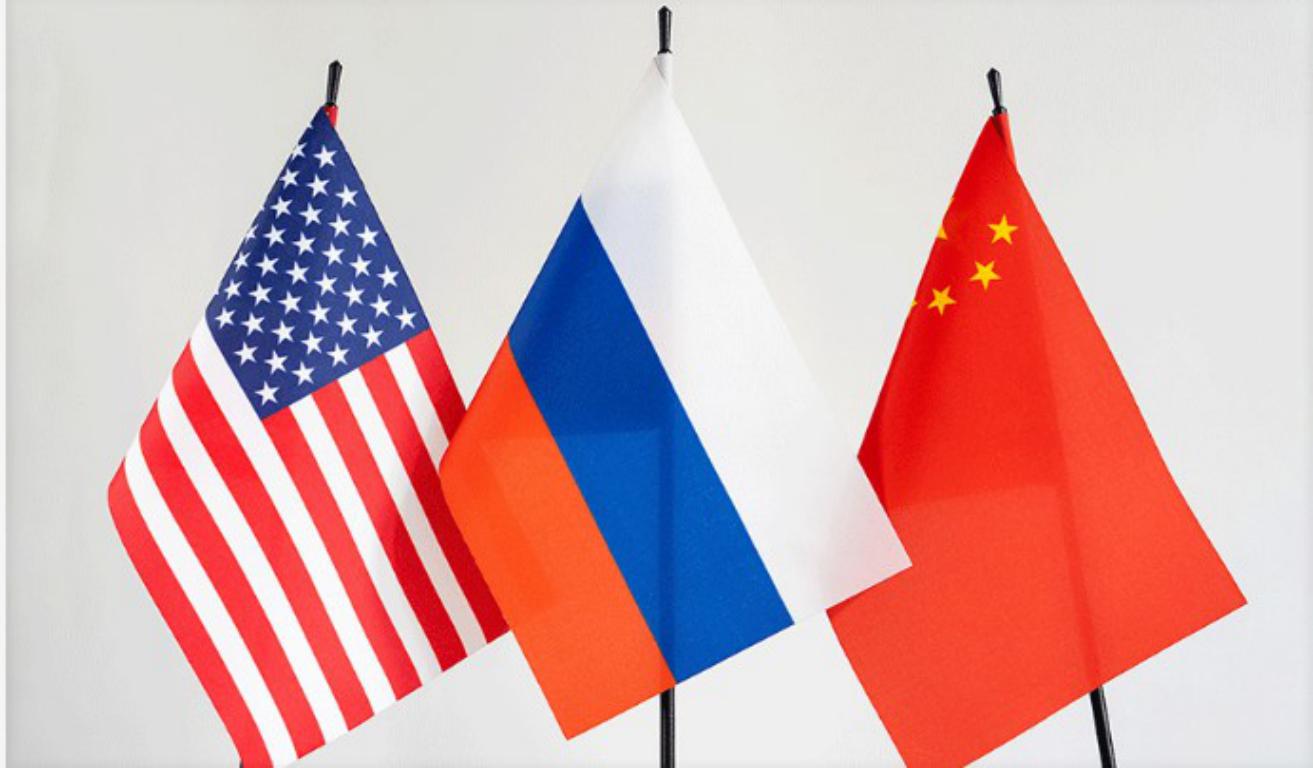
We are living through a period of sharp twists and turns. A new order of some sort appears to be emerging in the sense of a shift from the unipolar dynamics of the period after the fall of the Soviet Union and its East Bloc. But revolutionary activists must not give in to any illusion about alternatives to capitalism in any of the key players in this emergent multipolar world. Analyzing the three major powers in this multipolar world reveals no fundamental ideological differences, and none champions revolutionary social progress.
The United States is still the chief imperialist State-in-charge. The BRICS do not represent any significant alternative to what the United States represents. Neither Russia nor China is anti-capitalist. In fact, they both oppose the revolutionary potential of the global proletariat. It is the working class, in Russia, China, and across the world that can bring about a new liberatory order; socialism, through revolution that overturns the dictatorships of the ruling classes from Washington to Beijing, Moscow to London, and everywhere across the globe.
by Emmanuel IRO-OKORO