
House rents have increased at alarming rates in major urban centres such as Lagos and Abuja in recent years. This has led to widespread outcry by working-class people in these cities. Young professional middle-class netizens have also raised their voices online.
The trend of the high cost of housing and arbitrary rent increases by landlords which we have witnessed over the years for the past decade, took an alarming turn for the worse after the removal of fuel subsidy in 2023.
Lagos and Abuja are the most affected cities in the country due to extreme housing shortages and speculative investment flows into the real estate markets in both places. But this long-lasting accommodation problem is a nationwide issue, especially in towns and cities.
It was initially intensified by inflationary pressures and the cost-of-living crisis that followed the COVID-19 pandemic. Anti-poor people policies of the Bola Tinubu-led APC administration, such as the fuel subsidy removal and naira devaluation made a very bad situation for poor working people even more terrible.
These neoliberal measures dramatically increased the cost of living for poor tenants and construction inputs for building houses. Landlords in turn aggressively raised rents in a bid to maximise the returns on their landed property.
A Crisis for the Working Class
For working-class families, the housing crisis is not merely an inconvenience. It is a daily existential struggle. In many cases, workers spend well over 50% to 70% of their income on rent, leaving little for food, healthcare, or education. Informal settlements continue to expand, while homelessness and overcrowding intensify.
New tenants face particularly harsh conditions of exorbitant rents, agency fees, caution deposits, and illegal demands for one to two years’ rent upfront. These practices persist despite legal restrictions, reflecting a regulatory system that exists only on paper.
Meanwhile, the poorest layers of society; manual labourers, unemployed youth, and migrant workers from the hinterland are effectively excluded from formal housing markets altogether. They are forced into slums, unregulated peri-urban settlements, or into unsheltered living, often under bridges and even beside rail tracks in places like Oshodi in Lagos, putting their lives at risk.
The Rise of “Luxury” Absurdity
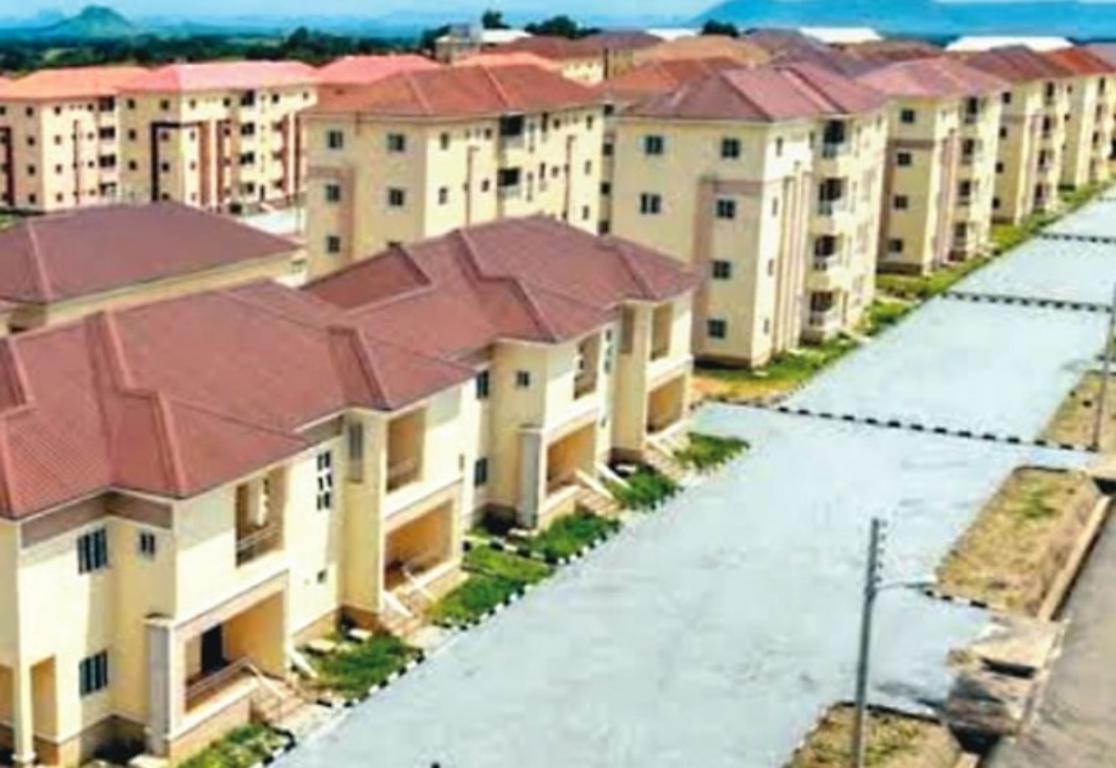
Alongside shabby homes in working-class communities, developers have gone to town building “luxury apartments” in closed-off estate complexes for the young and upwardly mobile across Lagos and Abuja. These “high-end flats” which are aggressively marketed by developers to the top-rung of upper-middle-class professionals who can afford it are, however, often poorly constructed and lack basic infrastructure.
They give a sense of security in a country where insecurity has become generalised, because they are gated, increasing the rush for them by the few who can afford it. And they have a gloss of “class” which the developers use to get away with listing them at absurd prices denominated in dollars or inflated naira equivalents.
But, what is marketed as “luxury” often boils down to superficial aesthetics like marble finishing, glass facades, and imported fittings, while fundamental issues like power supply, clean water, drainage, ventilation, and urban integration are neglected.
This trend reflects a deeper cultural shift in the Nigerian architectural space where buildings are increasingly designed as status symbols rather than functional living spaces adapted to local climate and social needs.
Passive cooling, communal design, and environmental harmony that were once central to traditional architecture are increasingly abandoned in favour of heat-trapping, energy-intensive designs that mimic Western styles which are not suited for tropical conditions.
The Real Estate Sector and Money Laundering
A critical dimension of the housing industry that is hardly ever discussed with the depth it requires is the role of real estate in money laundering. High value property transactions are frequently conducted with minimal transparency. This provides an avenue that is exploited for illicit wealth storage and capital flight.
Politicians, contractors, and business elites can park funds in luxury housing developments with little scrutiny, further inflating prices and disconnecting the housing market from real demand. This dynamic deepens inequality, as property markets become tools for wealth concealment rather than social provisioning of much-needed shelter for working-class people.
The Cement Oligopoly and Construction Costs
The cost of building materials, especially cement, has played a major role in driving housing unaffordability for the vast majority of the population. A handful of dollar billionaires who dominate and control Nigeria’s cement industry determine its production and pricing.
Despite continued significant expansion in installed capacity, production is often deliberately constrained to operating at around 50% capacity or less, allowing firms to maintain artificially high prices and surge production to undercut competitors who come in with lower prices. This reserve capacity model leaves the market closed off to incoming capital.
This oligopolistic structure functions as a price-fixing mechanism, ensuring super-profits at the expense of the broader economy and the needs of people. Therefore, although Nigeria is at the global bottom rungs of the ladder of per capita cement consumption, our cement companies have some of the highest profit margins in the world.
The result is a construction sector where even modest housing projects become prohibitively expensive, further limiting supply and reinforcing speculative pricing.
Underinvestment and State Failure
The government has invested nowhere near enough in housing and urban planning. Instead, it has effectively abdicated responsibility to private developers whose primary aim is profit maximisation. Nigeria faces a housing deficit estimated in the tens of millions of units.
Yet, there is no coordinated national housing strategy capable of addressing this gap at the required scale. Regulatory frameworks are weak, enforcement is inconsistent, and public housing initiatives remain minimal and under-funded.
Capitalism and Spatial Distortion
The housing crisis is not accidental. It is a direct outcome of the capitalist organisation of space and for-profit logic driving social-economic activities. Under capitalism, land and housing are treated as commodities that are subject to market forces aimed at maximising profits for the few, rather than promoting the delivery of social necessities to the people.
Investment flows toward high-profit segments (luxury housing), while low-income housing remains neglected because it offers lower returns. This leads to a distorted urban landscape with empty luxury apartments alongside overcrowded slums.
We thus see sharp rises in rents despite stagnant wages, and cities filled with housing designed for speculation rather than habitation. The very spaces people inhabit become expressions of class inequality.
Housing is a Human Right
Housing is recognised as a fundamental human right under international law, including the International Covenant on Economic, Social and Cultural Rights (ICESCR). Nigeria has ratified these agreements yet, it has failed to make them enforceable domestically.
The constitutional commitment to adequate shelter remains non-justiciable, rendering it effectively meaningless in practice. Instead of providing adequate shelter for the poor masses, slums and working-class communities are demolished to make room for buildings for the rich.
Tens of thousands of people have been rendered homeless and even some killed durng demolitions spree ruthlessly carried out by the state.
The Need for Revolutionary Change
The seriousness of the housing crisis reveals the limits of incremental reform. The current system, driven by the profit motive, speculation, and elite control, cannot deliver adequate housing for the vast majority of the population. What is required is a fundamental transformation.
A radical-democratic approach would treat housing as a public good, launch mass public housing programmes at scale, break up harmful monopolies in construction materials, regulate rents and outlaw exploitative practices, and Integrate housing with infrastructure, transportation, and good environmental planning.
Such a transformation cannot be achieved through policy tweaks alone. It requires the organised action of working people to challenge and ultimately replace the existing system.
Only through collective revolutionary struggle can society reclaim housing from the grip of rentiers, speculators, and oligarchs to reorganise it around human need for the many rather than for the profit of a few.
by Emmanuel EDOMWONYI