
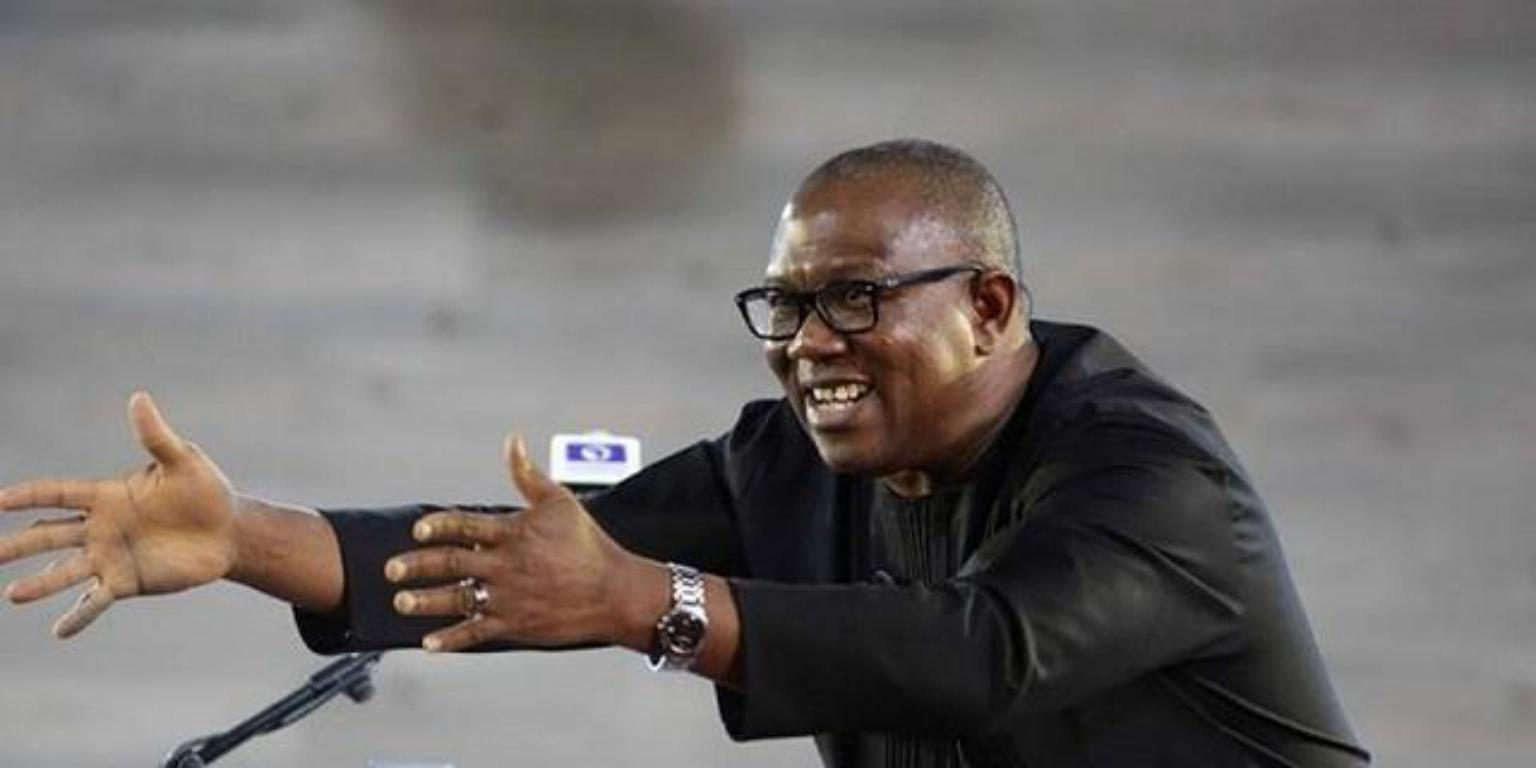
Like a chameleon placed on a politician’s shoulder, Peter Obi changes the colour of his public image to suit every new terrain. But the body beneath remains the same. That, more than anything else, is the story of his career: not the rise of a political outsider, but the movement of a familiar elite actor through different party vehicles, each one used as a new stage for an old script.
Peter Obi has over time become one of the most visible symbols of Nigeria’s opposition politics. But visibility is not the same as difference. He began in the All Progressives Grand Alliance, serving for two terms as governor of Anambra State from 2006 to 2014 on the platform of that party. He presented himself then as a loyal party man.
Yet in October 2014, he left APGA for the Peoples Democratic Party (PDP), becoming part of the economic team of President Goodluck Jonathan, who appointed him as chair of the Securities and Exchange Commission (SEC) in 2015. Obi further served the party as Atiku Abubakar’s running mate in the 2019 presidential election.
After suffering a defeat at the polls as President Muhammadu Buhari of the APC secured a second term in office, Obi departed PDP in 2022, joined the Labour Party (LP), and rode the wave of the 2023 election into national prominence. When that contest also ended in defeat, he moved again, this time into the African Democratic Congress (ADC), where he has since placed his hopes on contesting for president in 2027.
The sequence is plain enough: APGA, PDP, LP, ADC. However he dresses it up, the pattern is one of relentless political migration; an opportunistic habit that raises serious questions about conviction, consistency, and ideological depth.
That is why Obi cannot be taken seriously as a break from the traditions of the Nigerian ruling class. He is not outside this class; he is one of its most accomplished navigators. His journey reflects the central logic of elite politics in Nigeria, where parties are usually not instruments of principle but temporary shelters for ambition.
Obi is not an exception to the system’s decay. He is a refined expression of it. The difference between him and many of his rivals is not political morality but presentation, or to use a more common word in Naija: “packaging”. He speaks in a softer register, carries himself as a technocrat, and wraps himself in the language of rescue. But the underlying method is familiar: reposition, rebrand, and seek another platform for power.
His tenure as governor of Anambra State is often presented as proof of competence. Under his watch, as he repeatedly claims, Anambra posted strong results in national examinations after his administration invested in education and returned mission schools to church management.
He also left behind substantial reserves, with reports crediting him with more than ₦75 billion in savings by the time he exited office. That thrift earned him a reputation for prudence. In a country where public office is usually treated as an invitation to plunder, the image had obvious appeal
But this represents only a part of one aspect of the entire story of his tenure, during which he worsened the lives of poor working-class people and violated their democratic rights with impunity.
Thrift is not development, and savings are not governance in any fuller sense. During the same period, he was widely criticised for neglecting infrastructure and delaying local government elections, which pointed to a style of administration that was careful with money but less impressive in creating public goods. Roads, health facilities, and community-level development did not receive the same attention as fiscal discipline.
Surplus funds did not translate into development that touched the material lives of poor people. Obi’s record in Anambra therefore reveals a narrow neoliberal competence: he managed money tightly, but the broader social and material transformation that the masses required was lacking. He paid less than the national minimum wage to workers leading to a wave of strikes. Doctors also went on strike for thirteen months, but he did not care.
Obi’s governorship presents sharper contradictions when his public moral posture is compared to the controversies that followed him. The Pandora Papers revelations punctured the image of saintliness that many of his admirers had built around him and exposed the distance between his public rhetoric and private financial arrangements.
Reports showed he failed to declare offshore companies and bank accounts to the authorities, and the EFCC later summoned him over those undisclosed assets. That does not make him unique in Nigerian politics. It makes him recognisably similar to the class he is often praised for opposing, despite clearly being part of it. A politician who benefits from a culture of hidden wealth, offshore structures, and selective disclosure is not a purifier of the system. He is part of its machinery.
His handling of the pro-Biafra atmosphere in the South-East also deserves scrutiny. Exclusion, anger, and state violence have long shaped the region’s politics, and those conflicts have periodically involved Obi’s name. In 2013, over a dozen MASSOB members were killed, and their bodies were dumped into the Ezu River.
Critics of Peter Obi, who was governor at the time, claim that he had a hand in it. Seven years later, MASSOB exonerated him and blamed police officers associated with the Special Anti-Robbery Squad (SARS). But Peter Obi, as governor, utilised the same SARS to intimidate and repress.
That clarification matters because it prevents the easy distortion of events. Still, the episode is politically revealing. It shows that even in the region where he received about 90% of the presidential votes in 2023, the question of his relationship to agitation, dissent, and state force has been fraught. The aura of a unifier sits uneasily beside the record of a politician whose administration operated in a tense security environment and whose movement has often thrived on grievance without fully confronting its roots.
Then there is the matter of policy. During the 2023 campaign, Obi did not offer an essentially different economic project from the other contesting platforms of the ruling class. His manifesto embraced the elimination of the petrol subsidy, a position that aligned him with the broad neoliberal consensus shared by the APC and PDP as well.
He later confirmed on air that he would have removed the subsidy too, arguing only that he would have done it in an organised way. Whether carried out chaotically or neatly, subsidy removal remains the same basic idea: shifting the burden of adjustment onto the population while presenting austerity as reform.
But even Obi’s later claim that he would have done anything differently from Tinubu regarding the subsidy removal was a lie. He had said at the time that the subsidy “will go immediately” adding that “I cannot allow it to stay a day longer” on Channels Television.
Working-class people and youths who seek genuine, revolutionary change must critique capitalist politics, even when they are chameleonic. And the clearest tool for doing this is class analysis, using the Marxist method. This shows us that Obi’s politics are not a challenge to the ruling class; they are one of its more polished articulations.
His language of production, discipline, and private-sector revival belongs to the familiar lexicon of capitalist economics. He speaks of moving the country from consumption to production, but without a serious programme of redistribution, worker empowerment, or structural democratisation of economic power. He speaks of agricultural growth, energy reform, and investment, but within the same framework that has long allowed the bosses’ class to reproduce itself while calling its self-preservation national development.
His politics are technocratic rather than transformative, managerial rather than emancipatory. They promise competence, not liberation. And even that promise includes many lies.
Therefore, one should interpret his rise as a rearrangement within the same class formation, not as a pro-people rupture. In Nigeria, opposition politics too often becomes a competition among elite factions over who gets to manage the same anti-masses order. Obi’s movement, once again from one party to another, does not alter that structure; it confirms it.
He has moved with the currents of elite recalibration, entering each platform when it appeared useful and leaving when another offered better leverage. The rhetoric changes, but the class project does not. Subsidies are to be removed, the market is to be trusted, discipline is to be praised, and the people are to wait for the rewards that never arrive.
Seen this way, Peter Obi is less a contradiction to Nigeria’s political ruin than a polished version of its prevailing logic. He is not the opposite of APC or PDP. He is another branch of the same tree, another coat in the wardrobe of a ruling class that has mastered the art of wearing different colours while defending the same order.
by Ayoola BABALOLA