
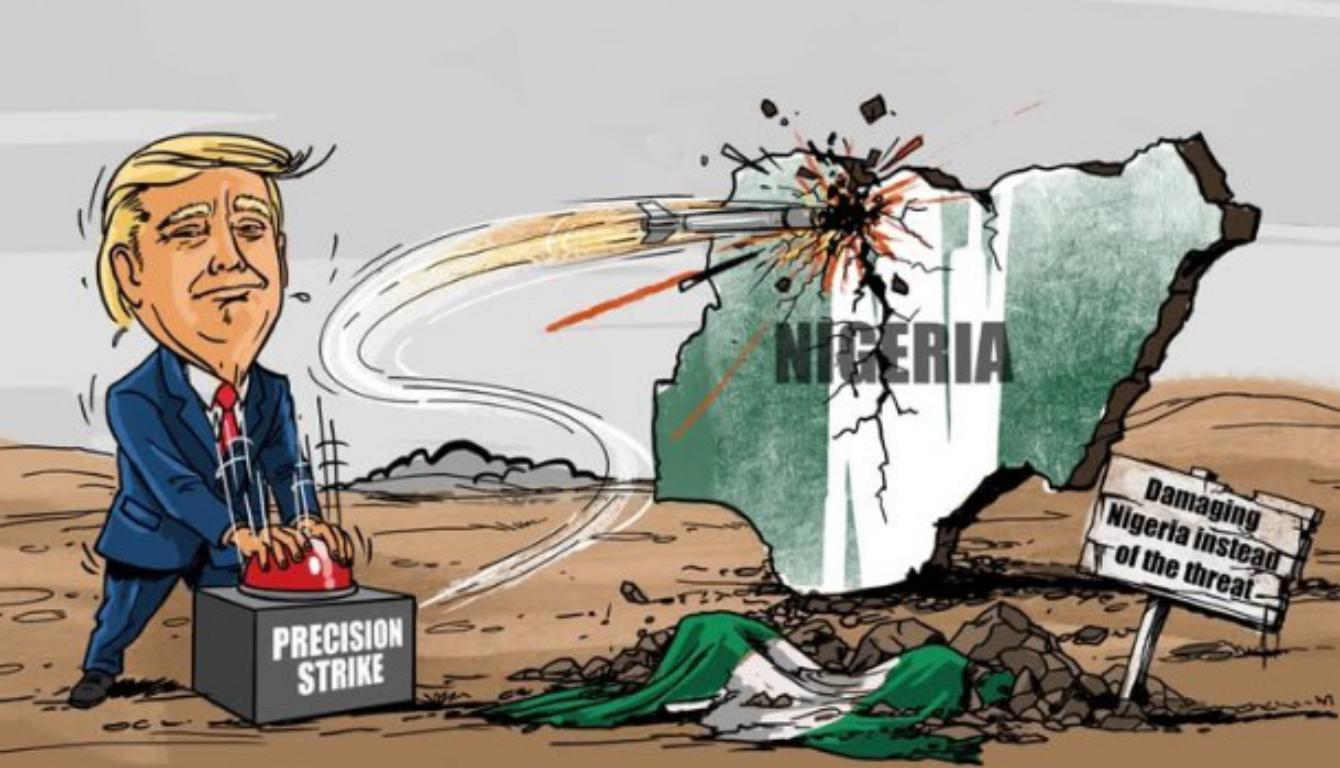
Nigerians woke up on Boxing day to the news of a “Christmas present” from the United States. In a series of air strikes, tomahawk missiles rained on rural settlements in the Tambuwal and Tangaza Local Government Areas of Sokoto State, Northwestern Nigeria. US President Donald Trump announced these attacks in a social media post, boasting that he had directed “a powerful and deadly strike against ISIS terrorist scum in Northwest Nigeria”. The action was a brazen follow-up to his threat in November to storm the country with “guns-a-blazing”.
Pete Hegseth, the United States secretary of Defence echoed his boss’s boasts, highlighting that Trump had made such a possibility “clear last month” with the spin of stepping in to stop a Christian genocide, due to his supposed love for Nigerian Christians. He did not stop there. He expressed the United States gratefulness to the Nigerian government for its “support and cooperation” in enabling the strike, adding that more of such bombing is to come.
It took hours after the strike before the Nigerian state confirmed that it was part of an ongoing “joint collaboration”. This underscores the junior partner role of the Nigerian ruling class to United States’ imperialism, in the “joint coordination” of the air strikes.
“Guns a-blazing” based on lies
At the beginning of November, President Donald Trump of the United States of part of North America had posted on his social media account the US would come into Nigeria “guns a-blazing” to defend Christians. He claimed that there is an ongoing “Christian genocide” in the country. After that, this United States put Nigeria on its list of Countries of Particular Concern.
But Donald Trump has little concern for Christians in Nigeria or anywhere else. He is playing to the gallery of his support base amongst evangelicals in the United States. His acolytes in the US Senate and Congress like Ted Cruz and Riley relied on dubious data from a nebulous non-governmental organisation in Nigeria to buttress the narrative of an anti-Christian genocide.
The NGO known as “International Society for Civil Liberties and Rule of Law,” which is essentially made up of an evangelical couple and their friend of a similar disposition has a history of manipulating figures. As the BBC also pointed out, it has provided no list of its sources for verification. This is not surprising.
It is also not surprising that the United States acted on this questionable data. The United States itself has a long history of using lies and fabrications to justify imperialist attacks. Its justification of an attack on Venezuela with false claims of drug trafficking only to show its true interest, which is to seize the country’s oil reserves is just the latest int his characteristic strategy of Yankee imperialism. We can also remember the lies about weapons of mass destruction in Iraq two decades ago, to gain direct inroad into the country’s oil.
Lingering questions and responses
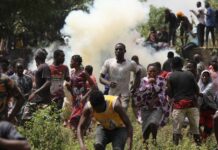
The tomahawks’ dispatch to Sokoto state exposed the fraudulence of Trumpist-imperialist politics overall and its simplification of the country’s complicated insecurity as a Christian genocide. First, as eyewitness accounts immediately indicated, and which was confirmed weeks after by the Washington Post, the strikes were far less successful than they were made out to have been. Despite claims that the targets were Jihadist groups, the available evidence are those of unexploded missiles or shrapnels in relatively peaceful rural communities like Jabo and Birikini. It is also worthy of note that the United States and the Federal Government of Nigeria gave diverging accounts of the strikes.
The Lakurawa group (aka Islamic State Sahel Province, ISSP) appears to have been the intended target. Reports indicate that two of its camps might have been hit, but there are no reports of casualties. But the victims of this armed group, the people and communities its militants terrorise, are Muslims. Paid vigilantes, invited by communities in Sokoto and Kebbi states almost a decade ago to help them fight against unceasing bandit incursions, evolved into the Lakurawa group, underscoring the complexity of the situation. But even now, the main militant groups in those two states and the adjoining Zamfara State remain armed bandits without radical Islamist ideological commitment. They kidnap for ransom, and even levy taxes on rural communities, strictly for pecuniary reasons.
These dynamics are not appreciated by many people, including working-class Nigerians and even activists, who welcomed the Christmas air strikes. And even few of those who condemned it put the complexity of the situation in perspective. The responses to the attacks largely followed the broad lines of the spectrum of responses to the earlier threats in November. But there was a more welcoming turn to the action than the earlier threat to carry it out.
A leading television anchor and longstanding columnist, Dr Reuben Abati described anyone who is not happy with the bombing as being “unpatriotic”, on the Arise TV’s daily “The Morning Show”, within hours of the air strikes being made public. Leading Churches such as the Anglican Communion and the Pentecostal Fellowship of Nigeria hailed the air strikes. On WhatsApp groups and in discussions on the streets and cafes, one could hear and feel that frustration at the continued spate of insecurity and the Nigerian state’s inability to curb this has been translated into support for the action.
What is often left out of the discourse of those, in Nigeria and globally, who welcomed the strikes and indeed the very claim of Christian genocide, is the fraudulence at the heart of the “data” they rest such genocidal claims on. As I earlier pointed out, in describing these as nothing but tall tales, the trails of this claim all lead to one Emeka Umeagbalasi and his nebulous InterSociety group. And he is someone very much wont to exaggeration. In addition, he is a supporter of the Indigenous People of Biafra (IPOB) a secessionist group of Igbos in the largely Christian Southeast. Groups affiliated to this platform based in the United States have also been active in lobbying evangelical American lawmakers to line up with the genocidal narrative, as part of their “war” against the Nigerian state. An example of this is the American Veterans of Igbo Descent (AVID) which described what people like Senator Ted Cruz are doing to push that narrative as an “outstanding job”.
The Zionist regime of Benjamin Netanyahu has also latched on to the narrative emerging from this mood of frustration. He had echoed Donald Trump on Christmas day saying that “Muslim militant displacement and attacks against Christians in Nigeria….must end now.” This is at the same time that the genocidal regime became the first country to recognise Somaliland in the Horn of Africa. Israel is thus not only playing the game of its United States backers. Its laughable concern for Nigerian Christians after killing 3% of the entire Christians in Gaza is more a demonstration of its geopolitical interest.
Objections to the air strikes have not all been principled against such strikes in general. For example, Sheikh Ahmad Gumi, an Islamic scholar who opposed it urged the Nigerian state to seek military assistance from China, Turkey and Pakistan instead of from the US. The opposition bourgeois Peoples Democratic Party also criticised the federal government for not announcing the air strikes first before the United States president, but had no problem with the air strikes, par se.
The Take It Back movement which is aligned with the revolutionary African Action Congress was one of the first civil society organisations to boldly speak out against the air strikes. In a press statement signed by its National Coordinator, Juwon Sanyaolu, it described Donald Trump and the United States as foreign aggressors, made connections between the repressive domestic policy of the ruling capitalist party and its subservience to imperialism and called for the resignation of President Bola Tinubu.
In an interview with The New York Times in the second week of January, Donald Trump said “I think that Muslims are being killed also in Nigeria. But it’s mostly Christians.” This way this was welcomed by leading mainstream media and commentators in Nigeria bothered on the nauseating. The Nation considered it an “admission,” whilst the Daily Trust declared it to be a “u-turn.” They fail to grasp the politics of legitimation of the United States’ self-ascribed policing role over the Nigerian state, which Trump further rubbed in saying that he’d love to make attacks on Nigeria “a one-time strike” but “it will be a many-time strike” if, as he still frames it, “they continue to kill Christians.”
A historical perspective of the situation
The claim of Christian genocide dangerously tries to simplify a more complex reality of generalised violence and insecurity, and then exploit this narrative for political interests. Earlier in June 2025, violence-related deaths in Nigeria was reported as “a public health crisis” in the Lancet, which pointed out that “terrorism, banditry, herder-farmer or communal clashes, and gang-related or extra-judicial killings” had claimed 169,033 lives between 2006 and 2021. This shows the multilayered dynamics of the killing field that Nigeria has become. But it is important to look even more closely at the drivers of these, and interrogate the claims of Christian genocide within this context.
A closer look shows how capitalist exploitation, imperialist design, divisive politics of manipulation by the local ruling class, and the climate crisis, have contributed to unending bloodbath in Northern Nigeria. It also shows who the victims of these bloodletting are: poor working people, Moslems and Christians alike.
There are 371 ethnic groups spread across the six geo-political zones in Nigeria: three each in the north and the south. More than half of these are in the northern regions. 68% of the population of 230 million people are from the three dominant ethnic groups: the Hausa-Fulani in the core north comprising 29%, the Yorùbá in the Southwest comprising 21% and the Igbo in the Southeast comprising 18%. The middle-belt zone in the north comprises a wide array of minority ethnic groups. The same thing goes for the south-south zone of the Niger Delta. The Southwest and Southeast are mainly mono-ethnic.
Britain played divide and rule with the diversity of peoples it cobbled together into a colonial state to further its imperialist expansion. At the heart of this strategy was also its co-opting of the local chiefs and emirs into the colonial state as “native authority”. This was called “indirect rule”. This tactic was most successful in the north with the emirate structures.
The native ruling class that took over from the colonialists at independence in 1960 continued with divide and rule tactics in another form. They and the capitalist system they represent are incapable of bettering the lot of the working people. And they are primarily interested in their self-serving interest of enrichment. To maintain their rule, they play the ethnic and religious card repeatedly with the aim of dividing working-class people along ethnic and religious lines and distracting us from the main enemy, which is them.
This strategy led to a civil war which left about 2 million people dead within the first decade of independence, and several spells of bloodletting since then. The worsening economic situation for the poor working masses since the introduction of the structural adjustment programme in the 1980s, and particularly so since the global economic crisis of the 2000s has set an inflammable socioeconomic context.
The seeds of Salafi-jihadist politics were sowed not against Christians in the north, who are mainly in the middle-belt. They were sowed against Moslem leaders whose corruption were highlighted by these early militant Islamists in the 1980s and 1990s. They laid the foundation for what emerged in the 21st century as the armed Jihadist groups. Moslems in the Northeast were their first targets, and continue to be their targets as much as Christians.
Conclusion
The inability of the Nigerian ruling class to address the Frankenstein they helped to create has muddied the waters. Salafi-jihadist militancy has morphed with less ideological violence, including outright banditry and increasing clashes between herders and farmers. Addressing this complex situation requires a strategy that cuts through the Gordian knot of exploitation, suffering and oppression which feeds this hydra-headed beast. Reducing it to tall tales of Christian genocide will not help matters. If anything it has worsened the situation.
After Trump’s threats in November, there were renewed Salafi-jihadist actions. Over 300 pupils and 12 teachers were kidnapped from the St Mary’s Catholic School in Papiri, Niger state in the Northcentral zone on 21 November. This was just days after 25 girls were abducted from the Government Girls Comprehensive Secondary School in Kebbi, in the Northwest. Despite denials, it appears that the government paid huge ransoms to secure their release. The air strike has also not deterred strikes against poor working people. Two days after that, an Improvised Explosive Device (IED) was detonated on the highway in the largely Moslem Zamfara state of Zamfara, killing seven people. At least 30 people were killed in Niger state and many others kidnapped on 4 January. A few days later, there was a wave of abductions by armed marauders took place in Kwara, Katsina and Kaduna states.
The United States cannot stop the bloodletting in Northern Nigeria and across the country. The national ruling class of exploiters cannot either. As the National Chairperson of the African Action Congress Omoyele Sowore said: “only true, tested, and informed leadership can protect Nigerians – not imperilled, jaundiced neoconservatives operating from Washington DC.”
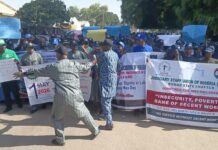
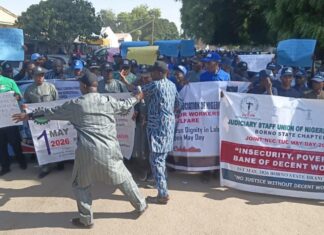
Such leadership can emerge only from revolutionary politics within the working class. The radical politics of the People’s Redemption Party (PRP) in the 1980s provided an alternative pole of attraction and bulwark for working-class people in the Northern states where it was active, when there was the first major wave of militant Islamism. One of the tragedies of the moment is the silence of the trade union movement at an hour such as this. There was no response to either the threats in November or the airstrikes on Christmas day.
A key task for socialists as rank-and-file workers and activists in the broader movement at the moment is to argue for working-class people’s unity and solidarity across all the lines the ruling class and imperialism want to divide us, including religion and ethnicity. We must also point out that it is the exploitative system of capitalism that feeds the monster of insecurity, while the divisive politics of the ruling class nurtures it.
To fully stop insecurity we must overthrow the system that feeds it. To curb its onslaught on us today, we must demand concrete steps to address the underlying social-economic issues. We must dare to take our fate in our hands against on all fronts, including to be able to defend ourselves against armed non-state actors and ultimately the state itself.
by Bàbá Ayé
Note:
- The article updated on 11th January, particularly the “lingering questions and responses” section, to capture more recent events.
- A Spanish version of the article has been published in Marx21 Bulletin 68 and is available here.