
At the end of the Cold War, Francis Fukuyama, a leading liberal philosopher, wrote a book titled The End of History and the Last Man. The central argument of the book was that liberal democracy was the final (highest) way of organising and governing society.
Over 30 years later, it has become self-evident that this claim is false. And in some sense, he admitted this himself. Unfortunately, anti-liberal politics and governance have not necessarily translated into socially progressive systems. Thus far, we see the growth of authoritarian governments and far-right movements around the world as the major manifestation of anti-liberalism.
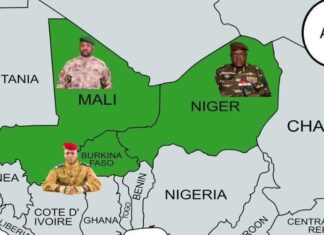
Many liberals, who had celebrated liberal democracy in the Western imperialist states, have reacted with fear at this rise in authoritarianism. But several political commentators, particularly on the African continent, have reacted with happiness or indifference as they feel that democracy has not worked in post-Independence Africa. Some even argue that “democracy” is not African and cannot work in Africa!
A study conducted by Afrobarometer last year showed that even though most Africans prefer democracy, the number is trending downward. The index of people’s support for democracy dropped by 7 percentage points in 2024. The sense of opposition to military rule also reduced, by 11 percentage points in 30 African countries. More than half of the African population is now willing to accept the military’s takeover of power to end the rule of corrupt and oppressive civilian governments.
Before we delve deeper into the mistaken view that the rise in authoritarianism or declining faith in any democracy is good, we need to have a clearer idea of what could be considered as democracy and liberal democracy, as well as an analysis of why this illiberal trend is happening now.
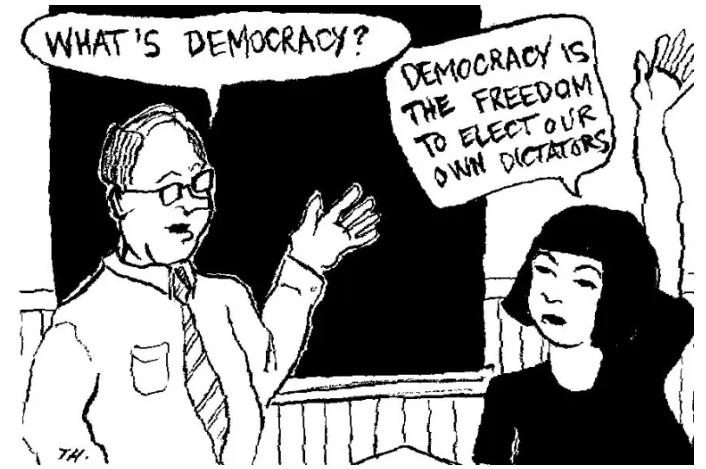
Simply put, we could say that democracy is a system of government and social organisation where most of a population influences the governing of the society. It is essentially majority rule within the specifically defined population, at least in form. Liberal democracy then, is the combining of liberalism and democracy.
Liberalism is a political philosophy that is based on individual rights and private property. Therefore, liberal democracy could be considered a system of government that everyone can take part in, at least formally, but which also prioritises individual rights, limits government intervention in the economy and defends the primacy of private property rights. In theory, the pillars of liberal democracy are; the rule of law, separation of powers, an independent judiciary and free and fair elections.
At first glance, liberal democracy might seem suitable for the function of a just society. But, as we see in our unfair world today, this is not the case. In fact, we have seen fascism rise from liberal democracy and lead to a devastating world war. This is not accidental. Capitalism, with its contradictions, is the foundation of liberal democratic society, and fascism of different sorts, as two sides of the same coin.
Neoliberal capitalism has underpinned the global political economy and liberalist ideology worldwide over the last 45 years. And it has created a more unequal world for poor people to live in. It contradicts and nullifies the farce of pillars of liberal democracy. The neoliberal means of organising society and production based on what is profitable and the false idea that “there is no such thing as society” have led to massive resource concentration and wealth inequality.
State-owned enterprises were sold to a handful of super-rich capitalists with the claim that it was the more “rational” and profitable thing to do. But this did not breed innovation. Rather, it just fattened the pockets of people who used social amenities created by the government that they acquired for a fraction of the price to make more profit.
This concentration of wealth, which is enhanced by the selling off of government assets and other practices like giving government money to private companies to fund research from which they only benefit from has led to massive concentration of wealth among a small section of the population. We can also see close ties between economics and politics. A lot of those that state-owned enterprises were sold to are political figures or friends of those in power. With their increased wealth and continued hold on the reins of state, they are better positioned to pervert free and fair elections. This further reinforces governments acting in the interest of the rich rather than the mass of people.
Furthermore, it is crucial to understand that the concept of “the people” as simply being a collective of individuals is a fabrication, and the idea of a nation’s collective desires is an ideological fraud of liberal democracy. Countries are made up of people belonging to different classes. The concept of a people masks the fact of two main classes in capitalist society, who have opposing interests. These are the class of those who own property, mainly capitalists, and the propertyless working class, also called the proletariat..
The class of rich people who own the means of production is also the one that controls political power through the state. When they talk of what the nation wants, they primarily mean what benefits their class within the country.
We also have to examine the ideology of separation of powers, since all state power — be it executive, legislative or judicial – belongs to the capitalists, anyway. Another ideal of liberalism contradicted by the reality of capitalist society is the idea of the rule of law and the so-called independence of the judiciary. The idea of the rule of law as something reflecting equality for everybody is false when we do not have social and economic equality. Even in the most “lawful” of countries, the way laws are written and punishments served makes the burden of rich persons lighter compared to those of poor people.
For example, where you have to either pay fines or go to jail, the poor person who cannot afford to pay a fine is the one that goes to jail while the money that the rich person pays as fine might have no meaning to him or her because of their wealth. So, you will see a stockbroker get off with a fine for fraud running into millions of naira, while a single mother has to serve a three-year sentence for stealing diapers from a store.
Sometimes, rich people also go to jail. But this is very rare, and it is usually under better conditions than the poor because, even inside the prisons, rich people get privileged treatment because they can pay for it. It is also interesting to note that entry into the law profession is one of the highest globally, in financial terms. And the rich are willing to pay more for outstanding lawyers willing to represent them than working-class people can. Corporate lawyers are richer than those in civil rights fighting for the oppressed.
Coming back to the relationship between liberal democracy and fascism, it must be said that they both serve to promote the sustainability of capitalism, even if in different ways. Liberal democracy, by giving us illusions of a just capitalism, while fascism is when the capitalists need to use their class’s thugs when the failure of liberalism becomes very clear.
That is how Nazism flourished in Germany on the soil of the liberal Weimer Republic through democratic means. And in Italy also, liberal politicians and economists were willing to, and did work with Mussolini to establish power and prevent the rise of the communists. Liberal governments around the world refused to interfere to preserve Spanish democracy from losing to Franco’s dictatorship only to legitimise it later. But then why does this happen? Why is it way easier for fascism to rise from liberal democracy than something else like communism?
At the core of both liberalism and fascism is the willingness to protect capital from the working class and their advocates like communists. Fascism emerges because of the contradictions of liberal capitalism as an attempt of the ruling class to solve these with brutality, rather than address social inequality or to unify a “nation” through myths and folktales.
Also, the liberal idea of “the marketplace of ideas” does its bit in enabling fascism’s rise. A theoretical idea of liberalism is that every idea has to be heard and to be put on the marketplace of ideas but while the liberal ideologues push this idea, they, at the same time, demonise socialism and socialist ideas, thus helping to leave the grounds of ideological contestation more open for the flourishing of other capitalist ideas, including illiberal ones like fascism.
Another significant feature in the rise of fascism from liberalism and something that certainly aids it is the increasing use of the police against the left. This happened in the Weimer Republic, the liberal precursor to the Nazi Third Reich, which was the most devastating fascist state in history. The Weimer Republic’s tail end saw a massive police crackdown on leftist movements. Social democrat police chief Karl Zorgiebel ordered a high-profile massacre on May Day in 1929 in response to communists defying a May Day street parade ban. Subsequent mass arrests and crackdowns followed this and the banning of the youth wing of the German Communist Party (KPD), while the youth wing of the Nazi Party was never banned.
Lawfare also significantly targeted the left. Several left-wing leaders were as well assassinated and many more were convicted. Meanwhile, right-wing provocateurs got off very easily. There are worryingly parallel situations happening before our very eyes today. Several liberal democratic states, including the United States, the United Kingdom and Germany, have launched crackdowns on the left, working-class people, and popular movements .
If we are to go by Aime Cesaire’s definition of fascism as colonial violence reinforced back into the imperial countries, then we see that the relation between liberalism and fascist actions might even be deeper, extending into the dynamics of imperialism. To be clear, this did not end with the end of 20th century colonialism, as the neo-colonial era has been defined by a continuation of capitalist imperialism which includes practices such as Western imperialist-backed coups in places like the Congo, Indonesia, Iran, Guatemala, Ghana, Burkina Faso, and Chile as well as crackdowns on communists or left nationalists by new local governments beholden to Western imperialism.
Radical democratic practices in the Global South are strangled, and movements for revolutionary democracy are vilified and extinguished. When that was not possible outright invasions were carried out as was the case in Haiti and Grenada. In countries where they had their puppets, when these became problematic for them, even if their politics were not in the interest of the working-class people, imperialist forces also carried out invasions to make themselves seem like the good guys. This was the case in Iraq and Panama.
We need to disabuse the minds of well-meaning working-class people and youth in Nigeria who see liberal democracy as the ideal for Nigeria to achieve. When they imagine a better society, they think of places like the US, UK, France or Germany. However, they do not understand that these countries still have pervasive social inequality, and a handful of rich people are the people who mainly benefit from the immense wealth accumulated there.
We should not imagine the US as the sort of place we want Nigeria to be for us as the working people, if we knew how long it took for Flint Michigan to get water or that close to a million people there are homeless even when they are so many empty houses lying around the country
There can be no liberatory future on the basis of capitalism in any form, be this a liberal or an authoritarian future. We can only build a better society and emancipate ourselves in a socialist future, where classes will not exist, and exploitation will be a thing of the past. Then, and only then, will humankind have a society where power belongs to the people once and for all.
by Emmanuel IRO-OKORO